Sales Battle Cards for B2B SaaS Competitive Deals
Most battle cards don't fail because they're wrong. They fail because they're built for the wrong person. Someone in marketing or product management wrote a thorough competitive analysis, reformatted it slightly, and called it a battle card. The rep opens it mid-call, sees three pages of feature tables, and closes the tab. The deal moves forward with the rep improvising. Sometimes that works. Often it doesn't. The fix isn't more research. It's a different kind of document, built around a different job.
Sellers face a competitor in roughly 68% of deals, according to Crayon's 2025 State of Competitive Intelligence report. That's not a niche scenario. The competitive conversation is the norm. Yet only 26% of competitive intelligence professionals say their reps actually use battle cards enough. That gap is the whole problem. Not a motivation problem. Not a research problem. A structural one.
When reps don't have a usable battle card, here's what they actually do:
- Research the competitor themselves, which takes time they don't have and produces inconsistent results
- Improvise on live calls, which creates brand risk and sometimes gets things flat-out wrong
- Avoid the competitive topic entirely and watch the deal drift to "no decision" or to the competitor by default
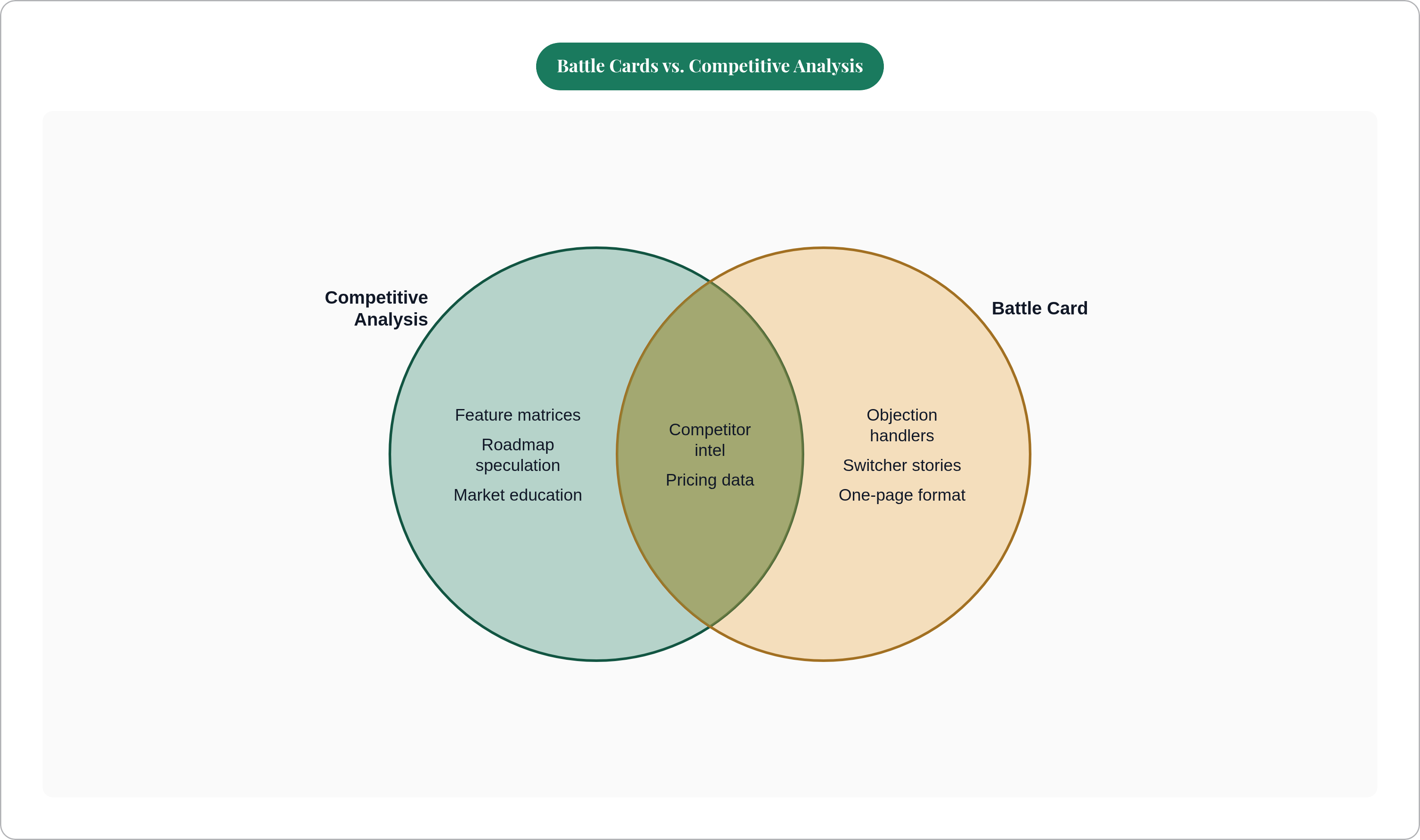
The root cause is that most battle cards are built as condensed competitive analyses. Product specs. Feature matrices. Positioning summaries. Those are planning documents. A battle card is a real-time decision aid. They serve different jobs and should be built completely differently. When a top performer leaves without a documented competitive playbook, the team doesn't move on. They relearn the same objections from scratch, which is exactly as painful as it sounds.
What a Battle Card Is Actually Supposed to Do in a Competitive Deal
The job is narrow. Help a rep navigate a specific competitive situation in the moment. Not educate them on the market. Not document product history. Get them through the next five minutes of a conversation they're already in.
Here's why that matters so much. The typical B2B buying group includes somewhere between six and ten decision makers, per Gartner. Each of them has been doing their own research independently. They've read reviews, watched demos, and formed opinions before a rep ever enters the picture. In fact, buyers complete roughly 70% of their evaluation before contacting a vendor, per 6sense's 2025 B2B Buyer Experience Report. By the time a competitor comes up in conversation, the buyer almost always already has a point of view. One shaped by that competitor's own messaging.
What that means for battle card design:
- Reps need to know what the competitor has already told the buyer, not just what your product does better
- The card has to address objections that arrive pre-formed, not just questions that emerge organically during a call
- Proof that maps to the buyer's actual situation will always outperform generic product claims
Battle cards fail when they're designed for the person who built them rather than the person using them. A rep mid-call, in a hurry, under pressure, needs something different than what a product marketer needs when building a launch brief. Format is part of the job definition. One page, scannable, bullets and bold text. A three-page document is not a battle card. It's homework a rep won't do.
The Sections That Belong in a Competitive Battle Card. And Why Each One Earns Its Place.
There's no mystery here. The sections that belong in a battle card are the ones that serve the rep in a live conversation. Everything else belongs somewhere else.
Competitive positioning snapshot. One or two sentences on how this competitor positions itself and what their sales team will say. Reps need to know what narrative they're walking into before the call starts.
Landmines to expose. The competitor's real weaknesses, surfaced from verifiable sources, not internal opinion. Three places to find these:
- Customer reviews on G2 or Capterra. Specific complaint patterns carry credibility. A support rating of 3.2 out of 5 with "slow response times" as the top complaint in negative reviews is actionable. "Customers are unhappy" is not.
- Job postings. Open roles reveal product gaps, team instability, or strategic pivots the competitor hasn't announced publicly. A hiring freeze in sales means something.
- Direct product testing. Onboard a trial account. Document the friction. That's proof-quality intelligence.
Objection handlers. Scripted language for the three to five objections that reliably come up against this competitor. Written in the rep's voice, not marketing language. Each one should end with a question that re-centers the conversation on the buyer's actual need. The usual suspects: price ("they're cheaper"), feature parity ("they have that too"), and incumbent advantage ("we already use their other products").
Customer proof. This is the section most battle cards skip entirely. It's also the one that closes deals. More on this in the next section.
Pricing and packaging intelligence. Only what can be confirmed from public sources, sales conversations, or review sites. No speculation. Guessing at a competitor's pricing and getting it wrong in front of a buyer is worse than saying nothing.
What not to include: full feature comparison matrices, roadmap speculation, or anything that takes more than 90 seconds to read. If a rep has to read for 90 seconds to use the card, the card has already failed.
How Customer Evidence. Not Product Specs. Actually Shifts Competitive Deals
According to UserEvidence's 2025 Evidence Gap report, 78% of B2B buyers say the most important factor in their evaluation is proof of success with similar customers. Not features. Not pricing. Not analyst rankings. Proof from someone who looks like them.
The reason this works the way it does isn't complicated. A story from a customer in the same industry, same role, same company size resonates because buyers project themselves into it. They stop evaluating your product and start imagining themselves using it. Generic praise doesn't do that. A specific story does.
Switcher stories are the highest-value format for competitive battle cards specifically. Here's why they work:
- They neutralize the competitor's positioning without requiring the rep to attack anyone
- They carry implicit landmine exposure. If the switcher left because of support quality or data portability issues, that surfaces the objection to probe without the rep having to assert it directly.
- The buyer hears a peer's experience rather than a vendor's claim. That's a completely different kind of credibility.
What makes proof trustworthy on a battle card:
- Specificity. Quantified outcomes, named industry, described challenge. Not "improved efficiency."
- Relevance. Matched to the competitor in question, not pulled from a generic testimonials library.
- Brevity. Two to four sentences is the right length for a battle card. Anything longer belongs in a full case study the rep can send as a follow-up.
That last point matters. The battle card proof block and the full case study serve different jobs. The battle card version is a hook that creates permission to send the longer asset. When you treat them as interchangeable, both get weaker.
One more thing worth knowing. The same UserEvidence report found that only a four-point trust gap separates named from anonymous testimonials (64% versus 60%). So the "we can't use unnamed customers" argument for keeping proof out of battle cards? It doesn't hold. Specific metrics and industry context carry the proof. The name is a nice-to-have. And separately, 67% of B2B buyers say they've ruled out a vendor due to untrustworthy evidence. Vague proof doesn't just fail to help. It actively damages credibility.
Where Competitive Intelligence Actually Comes From. And How to Keep It Current.
Not all intelligence is created equal. Here's how to think about the sourcing hierarchy:
- First-party sources (your own reps' call notes, CRM loss reasons, objection logs): highest relevance, lowest cost, chronically underused. This is the most valuable stuff and teams routinely ignore it.
- Review sites (G2, Capterra, Trustpilot): patterns across dozens of reviews surface real weaknesses that the competitor's marketing will never voluntarily reveal.
- Job postings: a competitor hiring several machine learning engineers signals a roadmap direction; a freeze in sales hiring signals instability. People forget how much a job board tells you.
- Direct product testing: onboard a trial account, document the friction, use that as proof-quality intelligence.
- Third-party sources (analyst reports, industry press): useful for context, but often lags the actual competitive reality by months. Use it last, not first.
Monthly refresh is the floor in SaaS. Quarterly is too slow for markets where competitors ship features and change pricing on a continuous basis. The best teams trigger updates on signals rather than schedules.
Those signals look like:
- A competitor announces a new integration
- A rep logs a new objection in the CRM
- A cluster of review-site complaints shifts
Single ownership is non-negotiable. One product marketing manager or competitive intelligence lead owns the card. Sourcing is distributed. Sales, product, and marketing all contribute signals. But the decision to update is not a committee decision. When everyone is responsible for updates, no one is, and the card goes nearly a year without a review. That's how battle cards die quietly.
The feedback loop that keeps cards alive is simple but usually missing: a frictionless way for reps to flag wrong or outdated information. A Slack channel, a CRM tag, a short form. Without it, the card decays silently and reps stop trusting it without ever saying so. They just stop opening it.
Getting Battle Cards Into the Hands of Reps Who Will Actually Use Them
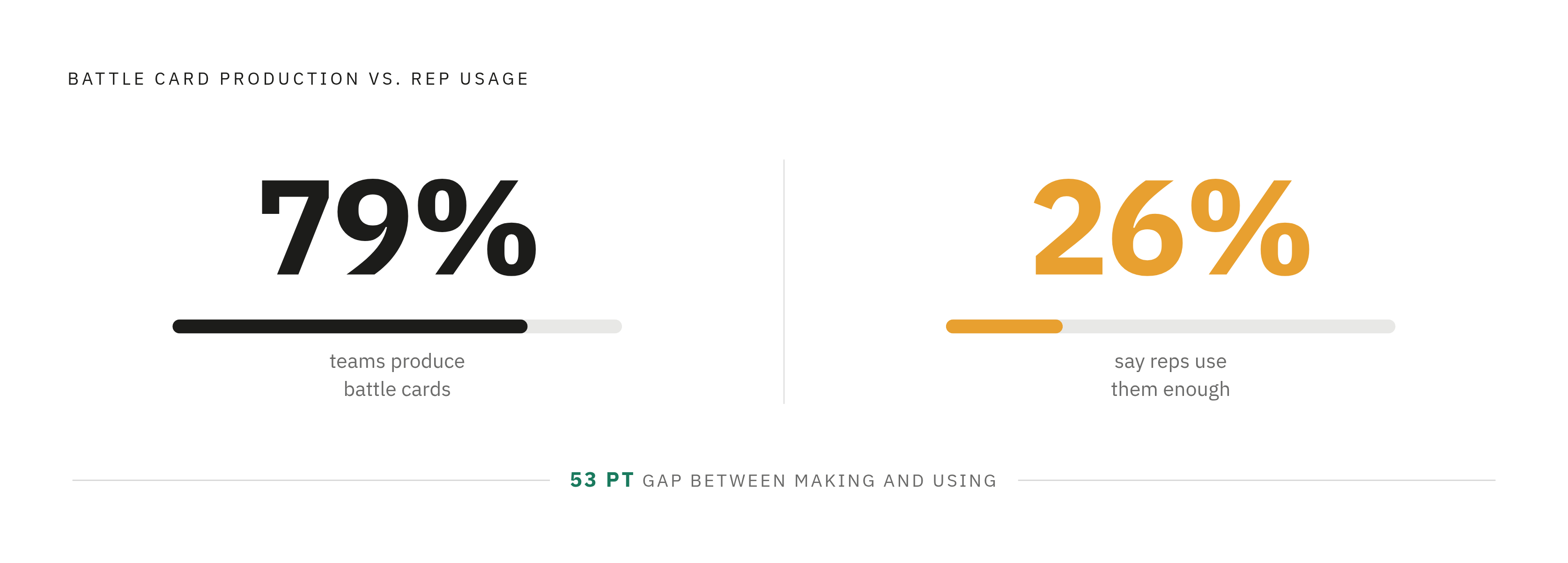
To recap the uncomfortable math: roughly 79% of competitive intelligence teams produce battle cards. Only about 26% say reps use them enough. That gap is almost entirely a distribution and discoverability problem. Not a quality problem.
The principle here is simple. Meet reps where they already are, not where you want them to go.
- Pin cards in Slack, searchable by competitor name
- Embed them in the CRM so the card surfaces when a competitor is logged on an opportunity
- Link from the sales playbook directly, not from a shared drive folder that requires three clicks and a search
A battle card buried in Confluence is not a sales enablement asset. It's a document that exists for compliance purposes.
Onboarding is a forcing function that most teams underuse. New reps who are walked through battle cards in their first two weeks develop the habit. Reps handed a folder link at week six never do. The window is early and it closes fast.
Usage tracking matters more than most teams realize. Which cards are being accessed, by whom, and at what deal stage. This data tells you which competitive situations are most common and which cards need the most investment. Without it, you're guessing at your own program's effectiveness.
One last thing about customer evidence: placing it inside the card changes usage behavior. When a rep knows the card contains a story they can send in a follow-up email, the card becomes a deal tool. Not a reference document. That's the shift. The card's job is not to make the rep an expert on the competitor. It's to give them 90 seconds of confidence and a clear next move in a conversation that's already happening.